The Existence of the Sky and Its Connection to Life: Seven Observable Domains of the Cosmos
1. The Universe and Its Large-Scale Structure
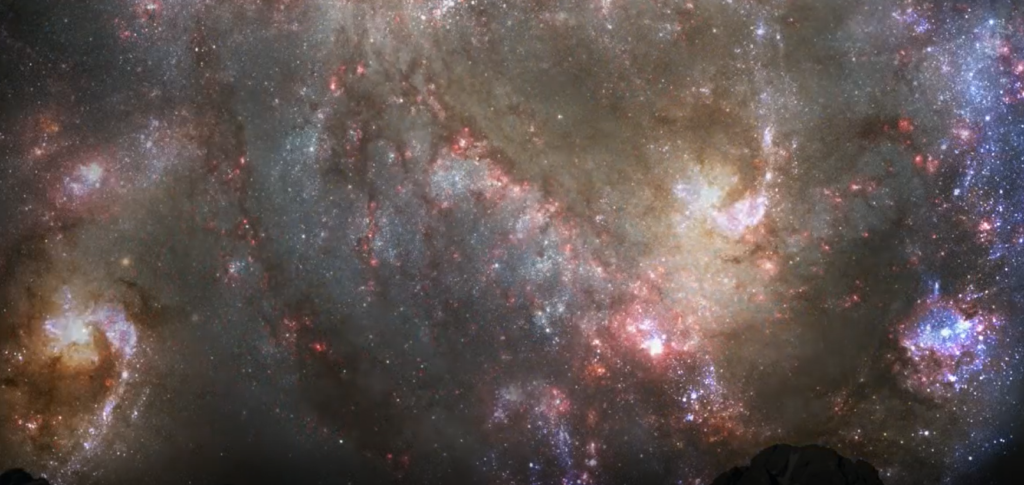
Space is the vast expanse beyond the Earth’s surface. With the naked eye, humans can observe celestial objects such as the Moon, the planets of the solar system, and the stars of the Milky Way galaxy. Through telescopes, observation extends far beyond the Milky Way, revealing other galaxies, as well as galaxy groups, clusters, and superclusters—large gravitationally bound systems containing hundreds or thousands of galaxies.
These structures are not randomly distributed; rather, they form an interconnected network known as the cosmic web. Galaxies are arranged along filaments, separated by vast empty regions called voids, and concentrated at dense junctions known as nodes. This structure is shaped by gravity and dark matter. Since the Big Bang, the universe has been expanding, with dark energy contributing to an accelerated expansion. As a result, distant galaxies appear to recede, a motion measured through redshift.
Due to this expansion, there are regions where space expands faster than the speed of light, preventing light from extremely distant galaxies from reaching us. What we observe today is light emitted billions of years ago—approximately 13.8 billion years after the Big Bang—when the expansion rate allowed that light to reach us.
2. The Observable Universe and Its Limits
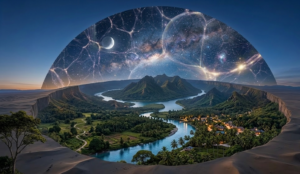
What we can observe forms a finite spherical region known as the observable universe, with an estimated radius of about 46.5 billion light-years. This boundary represents a limit of observation rather than a physical edge of the universe itself. Beyond this horizon lie regions that remain unobservable due to the finite speed of light and the ongoing expansion of space.
From an interpretive perspective, descriptions such as those in Surah Al-Mulk (verse 3), which suggest continuous observation without interruption, may be understood as consistent with the idea of a vast, continuous structure extending beyond what is observable.
3. The Concept of the Sky and Human Perception
The concept of the “sky” can be understood phenomenologically as what appears above observers on Earth—a dome-like expanse extending to the horizon without visible support, as referenced in Surah Al-Anbiya (32) and Surah Luqman (10). This perception depends on the presence of an observer within a planetary environment.
When a person moves beyond Earth’s atmosphere, this sense of the sky disappears; astronauts, for example, observe a dark background despite the presence of stars and sunlight. Thus, the idea of the sky is closely linked to observation from a life-supporting environment.
4. Life, Earth, and the Anthropic Perspective
Although the universe contains vast numbers of galaxies and star systems, life arises only under specific physical, chemical, and biological conditions, including the presence of water and suitable temperatures. Scientific understanding suggests that such conditions are rare.
The Qur’anic reference to multiple “earths” may be interpreted as indicating the possibility of other life-supporting worlds, though this remains interpretive rather than empirically confirmed. From Surah Al-Baqarah (verse 29), it is understood that Earth was prepared with the necessary conditions for life before human existence, which conceptually aligns with the anthropic principle—the idea that the universe’s conditions allow for the existence of observers.
5. The Seven Skies: An Interpretive Framework
The Qur’an refers to the creation of seven skies and seven earths, along with the presence of living beings within the skies. One interpretive approach is to understand the “seven skies” as distinct domains or levels of creation rather than strictly physical layers.
The Qur’anic term “tibaaqan” (Surah Al-Mulk, verse 3) has been interpreted as meaning “layered,” “arranged in levels,” or “corresponding.” This can be cautiously related to the cosmological principle, which states that the universe is homogeneous and isotropic—appearing broadly similar in all directions. Based on this, the seven skies may be understood as multiple corresponding domains within creation.
It may also be suggested, from a speculative perspective, that different regions of the universe are observable from different vantage points, and that the concept of “skies” could relate to such observational domains, particularly if life exists on other earth-like planets. However, such interpretations remain theological and should not be treated as established scientific conclusions.
6. The Universe, Creation, and the Mi‘raj
Astrophysical evidence indicates that the Earth formed long after the formation of stars and galaxies, meaning it did not precede the broader cosmic structure. From an interpretive standpoint, the formation of the universe began with the Big Bang, while the meaningful concept of “skies” may be linked to the presence of observing beings, though this is not a physical dependency.
Regarding the Mi‘raj of the Prophet (peace and blessings be upon him), the Qur’an does not explicitly state that he ascended through the “skies,” but rather that he was taken upward. Based on Hadith descriptions, this event may be understood as involving a realm beyond the observable universe—potentially analogous to Paradise—comprising forms of creation governed by different physical laws and constants unknown to us, and not limited by conventional physical space.